
How to File for Judicial Separation in India: Step-by-Step Process Before Divorce

Marriage is considered a sacred union in the Indian social fabric, but when a relationship faces an irreparable breakdown, the law provides mechanisms to protect the interests and mental well-being of both parties. While most people immediately think of Divorce in India, there is a significant intermediate legal remedy known as Judicial Separation.
Navigating the emotional and legal complexities of matrimonial disputes requires a balanced approach. Adv. Dhanashree A. Bankhele, a dedicated legal professional, specializes in guiding spouses through the Process of Judicial Separation, ensuring that their rights are protected while providing a window for potential reconciliation.
What is Judicial Separation?
In simple terms, Judicial Separation is a legal relief granted by the court that allows a married couple to live separately without terminating the marriage bond. Unlike a divorce, where the marriage is legally dissolved and parties are free to remarry, judicial separation acts as a “suspension” of conjugal rights.
According to Adv. Dhanashree A. Bankhele, the core difference lies in the marital status:
- Divorce: Ends the marriage; parties become single/unmarried.
- Judicial Separation: The parties remain “husband” and “wife” in the eyes of the law, but they are no longer legally obligated to cohabit or perform marital duties.
Contact now- 91 9967315556
Why Choose Judicial Separation Over Divorce?
Many couples opt for the Process of Judicial Separation for various reasons, including:
- Hope for Reconciliation: It provides a “cooling-off” period where the couple lives apart to gain perspective without the finality of divorce.
- Religious or Personal Beliefs: Some individuals may have personal or religious objections to the total dissolution of marriage but cannot continue living with their spouse.
- Statutory Requirements: Under the Hindu Marriage Act, a petition for divorce generally cannot be filed within the first year of marriage. However, a petition for judicial separation can be filed at any time.
- Financial/Legal Benefits: Since the marriage still exists, certain benefits regarding inheritance or insurance may remain intact.
Grounds for Judicial Separation in India
Under the Hindu Marriage Act, 1955 (Section 10), and similarly under the Special Marriage Act and other personal laws, the grounds for seeking judicial separation are the same as those for divorce. These include:
- Adultery: The spouse having voluntary sexual intercourse with any person other than their partner.
- Cruelty: Mental or physical harm that makes it unsafe or unbearable to live together.
- Desertion: One spouse abandoning the other for a continuous period of not less than two years.
- Conversion: One spouse ceasing to be a Hindu by converting to another religion.
- Incurable Insanity: The spouse suffering from a continuous or intermittent mental disorder.
- Venereal Disease: The spouse suffering from a communicable form of disease.
- Renunciation: One spouse renouncing the world by entering a religious order.
Adv. Dhanashree A. Bankhele emphasizes that proving these grounds in a petition for judicial separation requires meticulous evidence and expert legal drafting to ensure the court recognizes the necessity of the split.
Contact now- 91 9967315556
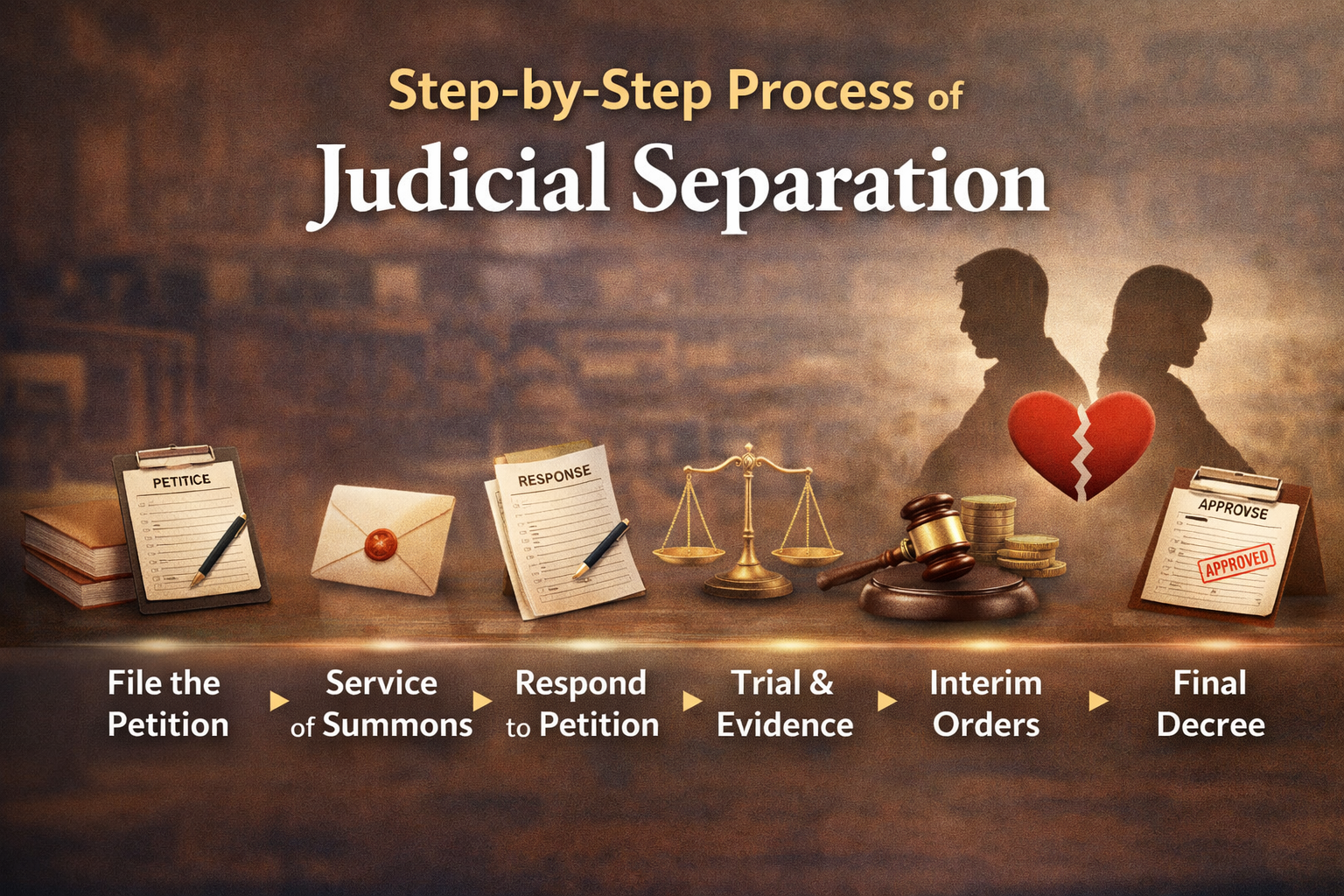
Step-by-Step Process of Judicial Separation
The legal journey for separation follows a structured civil procedure. Here is how the process unfolds under the guidance of Adv. Dhanashree A. Bankhele:
Step 1: Filing the Petition
The aggrieved spouse (Petitioner) must file a petition for judicial separation in the District Court or Family Court where:
- The marriage was solemnized.
- The couple last resided together.
- The respondent resides at the time of filing.
Step 2: Service of Summons
Once the petition is admitted, the court issues a formal notice (summons) to the other spouse (Respondent). This informs them that a legal proceeding has been initiated and provides them with an opportunity to respond.
Step 3: Response/Written Statement
The Respondent must file a written statement within the stipulated time, either admitting or denying the allegations made in the petition.
Step 4: Trial and Evidence
If the matter is contested, the court proceeds to the trial stage. Adv. Dhanashree A. Bankhele assists clients in presenting witnesses, documentary evidence (such as medical reports in cases of cruelty), and cross-examining the opposing party to establish the grounds for separation.
Step 5: Interim Orders
During the Process of Judicial Separation, the court can pass interim orders regarding:
- Maintenance: Financial support for the spouse and children.
- Child Custody: Determining where the children will live and visitation rights.
Step 6: Final Decree
If the court is satisfied with the evidence and finds that the grounds are valid, it passes a decree for Judicial Separation. Once this decree is passed, the parties are no longer required to live together.
The Shift to 2026: BNSS and Matrimonial Laws
With the transition to the Bharatiya Nagarik Suraksha Sanhita (BNSS) and the evolving legal landscape in 2026, procedural aspects of filing and evidence have become more streamlined. Adv. Dhanashree A. Bankhele remains updated on these procedural shifts to ensure that clients benefit from faster resolutions and modern evidentiary standards (such as digital evidence) in the Family Courts.
Contact now- 91 9967315556
Converting Separation into Divorce
It is important to note that if a decree for judicial separation has been passed and the couple has not resumed cohabitation for a period of one year or more, this becomes an independent ground for seeking a Divorce in India.
Adv. Dhanashree A. Bankhele often advises clients who are unsure about a final break to start with judicial separation. If, after a year, the differences remain unresolved, the transition to a divorce petition becomes legally straightforward.
The Role of Adv. Dhanashree A. Bankhele
Choosing the right path in a failing marriage is a heavy burden. Adv. Dhanashree A. Bankhele provides a supportive yet professional environment to handle these sensitive issues. Her role includes:
- Mediation: Attempting to resolve disputes through counseling before moving to court.
- Strategic Drafting: Ensuring the petition for judicial separation is robust and clearly outlines the grounds.
- Litigation: Representing the client’s interests vigorously regarding maintenance, alimony, and custody during the trial.
Contact now- 91 9967315556
Conclusion
Judicial Separation is a valuable legal tool for those who need a reprieve from a difficult domestic situation but are not yet ready or willing to sever the marital tie completely. It provides safety, financial security through maintenance, and the luxury of time to decide the future.
The Process of Judicial Separation can be daunting, but with the right legal counsel, it becomes a path toward peace and clarity. Adv. Dhanashree A. Bankhele stands committed to providing the expert guidance needed to navigate this transition with dignity and legal certainty.
FAQs
1. What is judicial separation in India?
Judicial separation is a legal remedy that allows married spouses to live separately without dissolving the marriage. The marital relationship continues, but cohabitation and certain marital obligations are suspended.
2. How is judicial separation different from divorce?
In judicial separation, the marriage remains legally valid, whereas divorce terminates the marriage completely. After divorce, both parties are free to remarry.
3. Under which laws is judicial separation governed in India?
Judicial separation is governed by personal laws such as the Hindu Marriage Act, 1955 (Section 10), Special Marriage Act, 1954, and other applicable personal laws.
4. What are the grounds for judicial separation in India?
Grounds include adultery, cruelty, desertion for a specified period, conversion to another religion, mental disorder, communicable disease, and renunciation of the world.
5. Can judicial separation be filed within one year of marriage?
Yes, unlike divorce, a petition for judicial separation can generally be filed at any time after marriage, subject to applicable legal provisions.
6. What is the procedure for judicial separation in India?
The process involves filing a petition in a competent court, service of summons to the other spouse, submission of responses, presentation of evidence, and a final decree by the court.
7. Which court handles judicial separation cases?
Judicial separation petitions are filed in the Family Court or District Court having jurisdiction based on marriage location, last residence, or respondent’s residence.
8. Can maintenance and child custody be decided during judicial separation?
Yes, courts may grant interim or final orders regarding maintenance, alimony, child custody, and visitation rights during the proceedings.
9. Can judicial separation lead to divorce later?
Yes, if spouses do not resume cohabitation for one year or more after a decree of judicial separation, it may become a ground for divorce.
10. What is the legal effect of a decree of judicial separation?
After the decree, spouses are no longer obligated to live together, but the marriage continues legally unless a divorce is obtained later.
Check more about – What is Bail in India?