
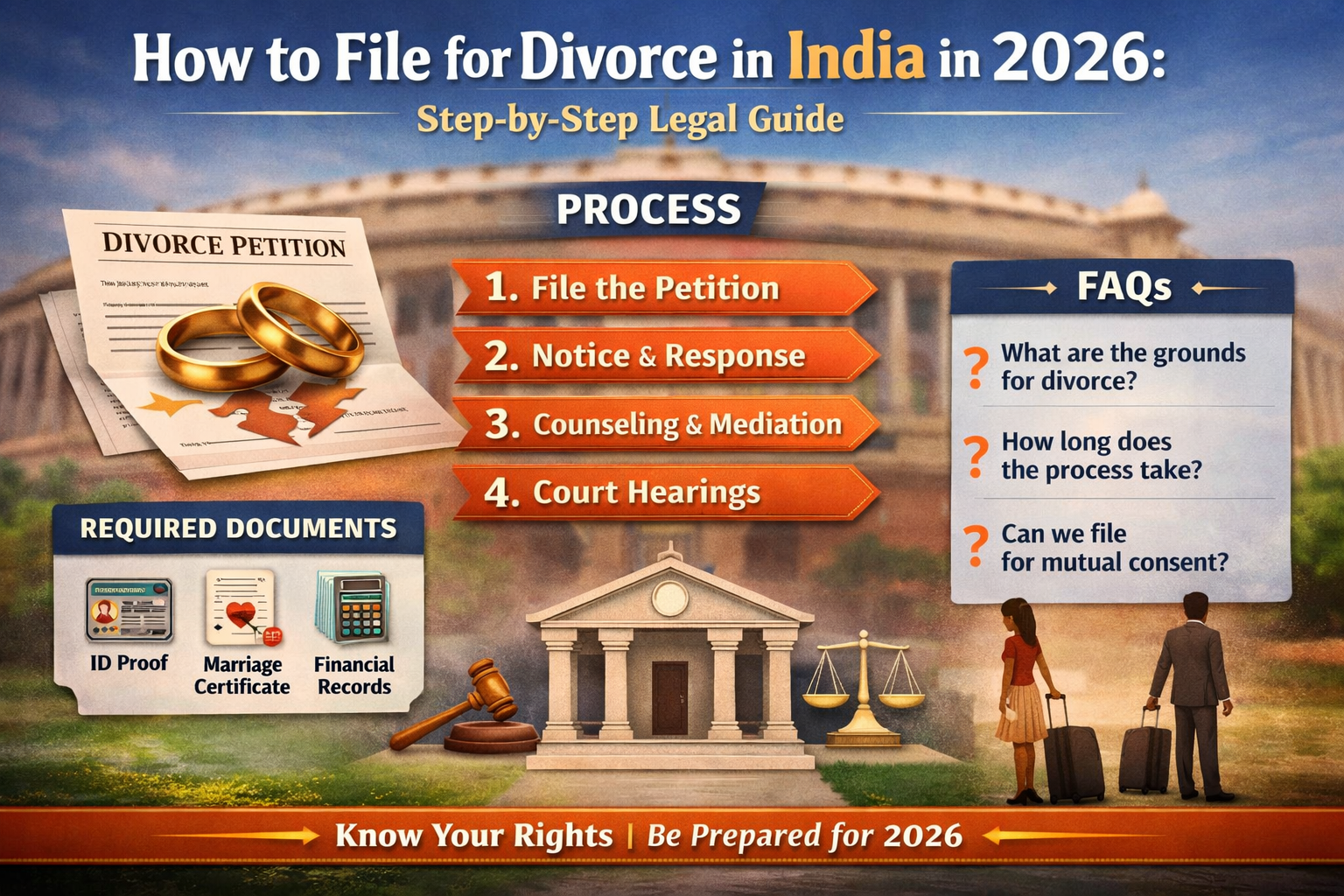
How to File for Divorce in India? Step-by-Step Legal Guide, Process & Documents

Divorce is never just a legal formality. It affects emotions, finances, children, housing, and future planning. That is why people searching for how to file for divorce in India in 2026 usually want one thing: a clear and practical guide they can understand without legal jargon.
The first thing to know is that there is no single divorce law for every marriage in India. The process depends on the law under which the marriage is governed. For Hindu marriages, the Hindu Marriage Act, 1955 remains one of the main laws, including Section 13 for divorce and Section 13B for mutual consent divorce. For civil marriages, the Special Marriage Act, 1954 provides separate divorce provisions, including Sections 27 and 28. Family Courts continue to handle these disputes in many places because the Family Courts Act, 1984 gives Family Courts the jurisdiction exercisable by district courts in marriage and family matters.
In 2026, the legal basics are familiar, but the way people file and track cases is more digital than before. India’s e-Filing system says civil and criminal cases can be filed before any High Court or District Court of the country through its end-to-end online filing platform, though actual local practice, scrutiny, and filing requirements can still vary by court and state.
This guide explains the divorce filing process in simple language, with practical steps, current legal context, and important questions people ask before starting.
Contact now- 91 9967315556
What Divorce Means in India in 2026
Divorce is the legal dissolution of a valid marriage by a court. In India, the legal route depends on the personal or special law that applies to the marriage. Under the Hindu Marriage Act, Section 13 lists grounds for divorce and Section 13B provides divorce by mutual consent. Under the Special Marriage Act, Sections 27 and 28 play a similar role for marriages under that Act. Christian and Parsi marriages are governed by separate laws, including the Divorce Act, 1869 and the Parsi Marriage and Divorce Act, 1936.
That means the first step is always to identify which law applies to your marriage. Without that, you cannot prepare the correct petition.
Types of Divorce in India
1. Mutual Consent Divorce
This is usually the simpler route when both spouses agree that the marriage has broken down and both want a divorce. Under Section 13B of the Hindu Marriage Act, a joint petition can be presented to the district court by both parties together, subject to the statutory conditions in that section. The Special Marriage Act also provides divorce by mutual consent under Section 28.
In practical terms, mutual consent divorce usually works best when both sides also agree on key issues such as:
- alimony or maintenance
- child custody and visitation
- child support
- division of assets and liabilities
- return of articles, jewellery, or documents
2. Contested Divorce
A contested divorce is filed by one spouse against the other when there is no agreement to end the marriage or no agreement on the reasons and terms. Under the Hindu Marriage Act, Section 13 provides statutory grounds for divorce. Under the Special Marriage Act, Section 27 sets out grounds for divorce.
This route usually takes more time because the other side can oppose the petition, file a written statement, produce evidence, and contest claims about facts, maintenance, custody, or property.
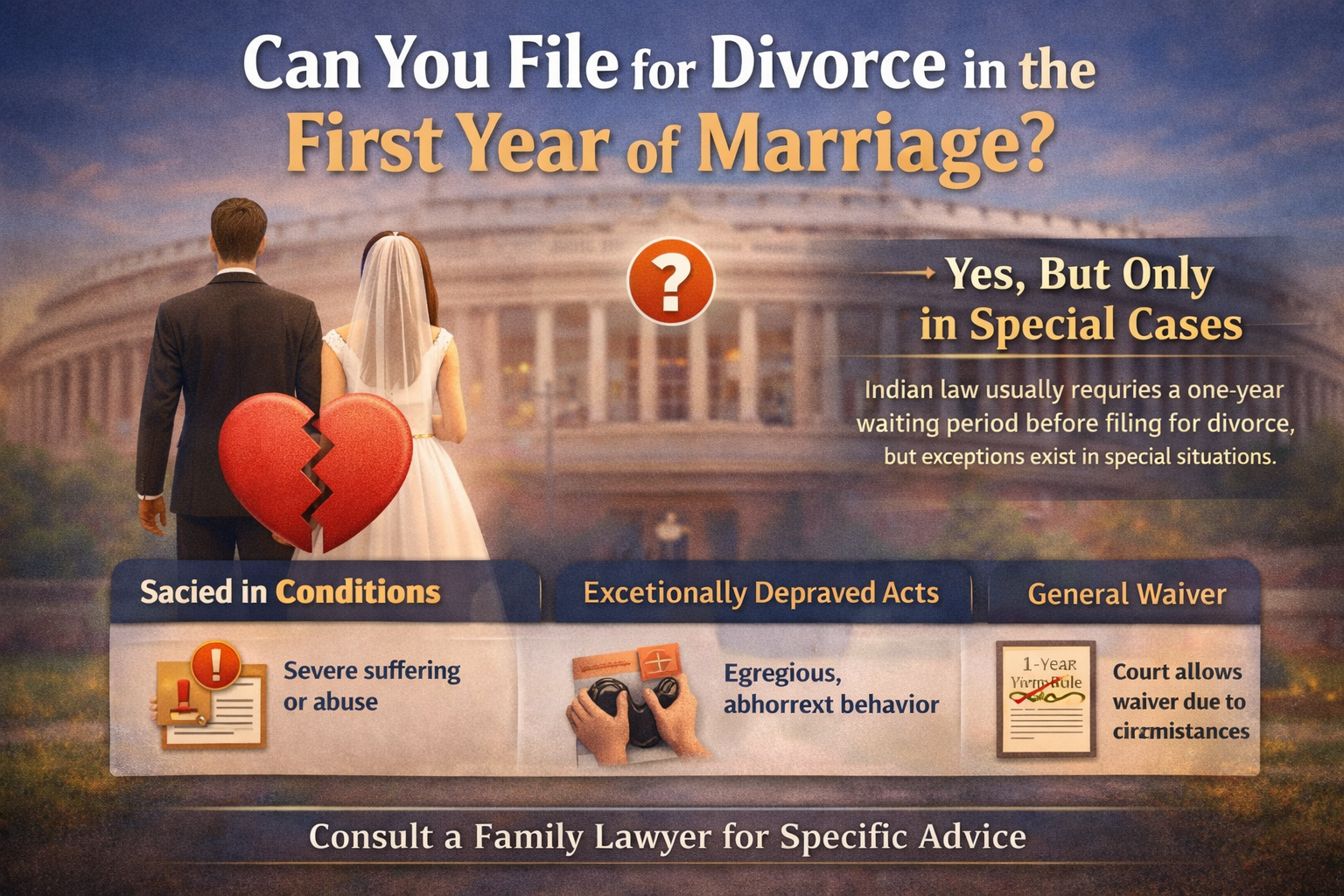
Can You File for Divorce in the First Year of Marriage?
Usually, not immediately. Under Section 14 of the Hindu Marriage Act, no petition for divorce can generally be presented within one year of marriage, and the Special Marriage Act also contains a restriction on petitions for divorce during the first year of marriage.
This is a very important point for searchers in 2026 because many people assume they can file at any time after separation. The answer depends on the statute and the facts, so the timing of marriage matters from day one.
Contact now- 91 9967315556
Which Court Do You File In?
In many cases, divorce matters are filed before the Family Court where one of the legally recognized jurisdiction links exists, because the Family Courts Act gives Family Courts the same jurisdiction that district courts exercise over matrimonial matters. The Hindu Marriage Act also contains a section on the court to which the petition should be presented, and the Special Marriage Act has parallel procedural provisions on jurisdiction and contents of petitions.
In simple terms, the petition is usually filed in the court that has territorial jurisdiction based on factors such as where the marriage was solemnized, where the parties last lived together, or where one of the parties presently resides, depending on the statute and facts.
Step-by-Step: How to File for Divorce in India in 2026
Step 1: Identify the Correct Law
Before drafting anything, identify how the marriage was solemnized or registered. A Hindu marriage, a civil marriage under the Special Marriage Act, a Christian marriage, or a Parsi marriage may follow different statutes and slightly different procedures.
Step 2: Decide Whether the Case Is Mutual or Contested
This is the biggest practical decision. If both spouses agree to divorce and agree on major terms, mutual consent is usually more efficient. If not, one spouse files a contested petition on legally recognized grounds. The legal sections differ by statute, but the basic choice between mutual and contested remains central in 2026.
Step 3: Collect the Required Documents
Most divorce cases require a basic set of documents. Courts may ask for more depending on the dispute, but the usual set includes:
- marriage certificate, if available
- wedding photographs or proof of marriage
- identity and address proof
- passport-size photographs
- proof of residence
- details of children, if any
- proof of separation, if relevant
- income documents for maintenance claims
- records relating to property, expenses, or abuse allegations, if relevant
The exact list can vary by court rules, but filing without proper documents can delay scrutiny and registration.
Step 4: Draft the Divorce Petition
The petition is the core legal document. It states the names and details of the parties, marriage details, place of residence, facts of the marriage, separation details, legal grounds, and the reliefs sought. Under the Special Marriage Act, there are explicit provisions on the court to which the petition should be made and the contents and verification of petitions. State-specific marriage rules also typically require verification in the manner used for civil pleadings.
If the matter is mutual consent, the petition is joint. If the matter is contested, it is filed by one spouse against the other.
Contact now- 91 9967315556
Step 5: File the Petition in the Proper Court
The petition is then filed before the Family Court or district court having jurisdiction. In 2026, some courts allow or support online filing through the national e-Filing system, which describes itself as an end-to-end solution for filing cases, plaints, written statements, replies, and applications before High Courts and District Courts. But local court practice still matters, so parties should check the relevant court’s accepted filing mode and scrutiny process.
For readers handling the process carefully, practical legal guidance from professionals such as Adv. Dhanashree A. Bankhele can be useful in ensuring the petition, annexures, and reliefs are presented properly from the start.
Step 6: Court Scrutiny and Admission
After filing, the court registry checks whether the paperwork is complete, properly signed, and supported by the required documents and court fee. If defects are found, they may need to be cured before the matter proceeds.
Step 7: Notice to the Other Spouse
In a contested divorce, the court generally issues notice to the respondent spouse. The other side then gets the chance to appear and file a written response. In a mutual consent matter, both spouses already appear together, so this stage is simpler.
Step 8: Conciliation or Mediation
Family law in India strongly favors efforts at settlement where possible. The Family Courts Act itself was enacted to promote conciliation and secure speedy settlement of family disputes. In practice, courts often refer parties to counselling or mediation, especially when there is still a possibility of settlement or agreement on children and finances.
This does not mean the parties must stay married. It means the court tries to see whether the dispute can be resolved with less hostility, or whether settlement on terms is possible even if divorce itself proceeds.
Step 9: Evidence, Hearings, and Interim Applications
If the case is contested, the court moves through pleadings, interim applications, evidence, and arguments. During this stage, one spouse may seek interim maintenance, child custody orders, litigation expenses, or residence-related relief under the applicable law. Under the Hindu Marriage Act, Sections 24 and 25 remain central for maintenance during proceedings and permanent alimony.
This is often the longest stage of a contested divorce.
Step 10: Final Order or Decree of Divorce
Once the court is satisfied that the legal requirements are met, it passes a decree of divorce. The decree may also decide connected issues such as maintenance, custody, visitation, and costs, depending on what was claimed and argued.
Contact now- 91 9967315556
Is Online Divorce Filing Fully Available in India in 2026?
Not in one uniform way everywhere. India’s e-Filing platform clearly states that filing can be done before any High Court or District Court through its online system, but the real experience can still differ based on state, district, court infrastructure, and case category. Case tracking after filing is also available through the eCourts services platform and case status portal.
So the practical answer is: digital filing is more available in 2026, but local court readiness still matters.

Common Mistakes to Avoid
Many people make avoidable mistakes when starting divorce proceedings:
- filing under the wrong law
- choosing the wrong court
- filing before the statutory waiting period allows it
- leaving out key facts
- not attaching proof documents
- ignoring maintenance, custody, or asset issues in the petition
- assuming mutual consent means “no paperwork”
- relying on informal separation instead of a proper decree
A well-prepared petition usually saves time later.
Final Thoughts
If you want to understand how to file for divorce in India in 2026, the simplest way to remember the process is this: first identify the law, then identify whether the case is mutual or contested, gather documents, draft the petition carefully, file in the proper Family Court or district court, and then follow the court’s process on notice, mediation, evidence, and final decree. The law is still statute-driven, but the filing ecosystem is more digital than before because e-Filing and eCourts services are increasingly integrated into court practice.
Divorce is a legal process, but it is also a life transition. Clear information helps people make calmer and better decisions.
Contact now- 91 9967315556
FAQs
1. How do I file for divorce in India in 2026?
You first identify the law governing your marriage, then prepare a mutual or contested divorce petition, file it in the proper Family Court or district court, and follow the court process for notice, hearings, and final decree.
2. What is the difference between mutual and contested divorce?
Mutual consent divorce is filed jointly by both spouses who agree to end the marriage, while a contested divorce is filed by one spouse on legal grounds against the other.
3. Which court handles divorce cases in India?
Family Courts usually handle matrimonial matters where they exist, because they exercise the jurisdiction of district courts in family disputes.
4. Can I file for divorce online in India in 2026?
Online filing is available through the national e-Filing system for High Courts and District Courts, but the practical availability and process can still vary by court and state.
5. Can I file for divorce within one year of marriage?
Usually, divorce petitions are restricted during the first year of marriage under statutes such as the Hindu Marriage Act and the Special Marriage Act, subject to legal exceptions.
6. What documents are needed for divorce filing?
Common documents include marriage proof, identity proof, address proof, photos, separation details, and income records where maintenance is in issue.
7. Is a marriage certificate mandatory for divorce?
A marriage certificate is very useful and often expected, but other proof of marriage may also become relevant depending on the case and law.
8. How long does a divorce case take in India?
There is no single timeline. Mutual consent cases are usually faster, while contested cases can take much longer because of notice, evidence, and interim applications.
9. Do courts try mediation before granting divorce?
Yes, family courts often attempt conciliation or mediation because the Family Courts Act was designed to promote settlement of family disputes where possible.
10. Can I ask for maintenance during the divorce case?
Yes. Under the Hindu Marriage Act, Section 24 allows maintenance during proceedings, and Section 25 deals with permanent alimony and maintenance.
11. Can custody and child support be decided in the same divorce case?
Yes, courts commonly deal with connected issues such as child custody, visitation, and support along with divorce proceedings, depending on the pleadings and applicable law.
12. Does mutual consent divorce mean there will be no court appearance?
Not necessarily. Even in mutual consent cases, court appearances and compliance with statutory procedure are still part of the process.
13. Can Christians and Parsis file for divorce under separate laws?
Yes. Christian marriages may fall under the Divorce Act, 1869, and Parsi marriages under the Parsi Marriage and Divorce Act, 1936.