
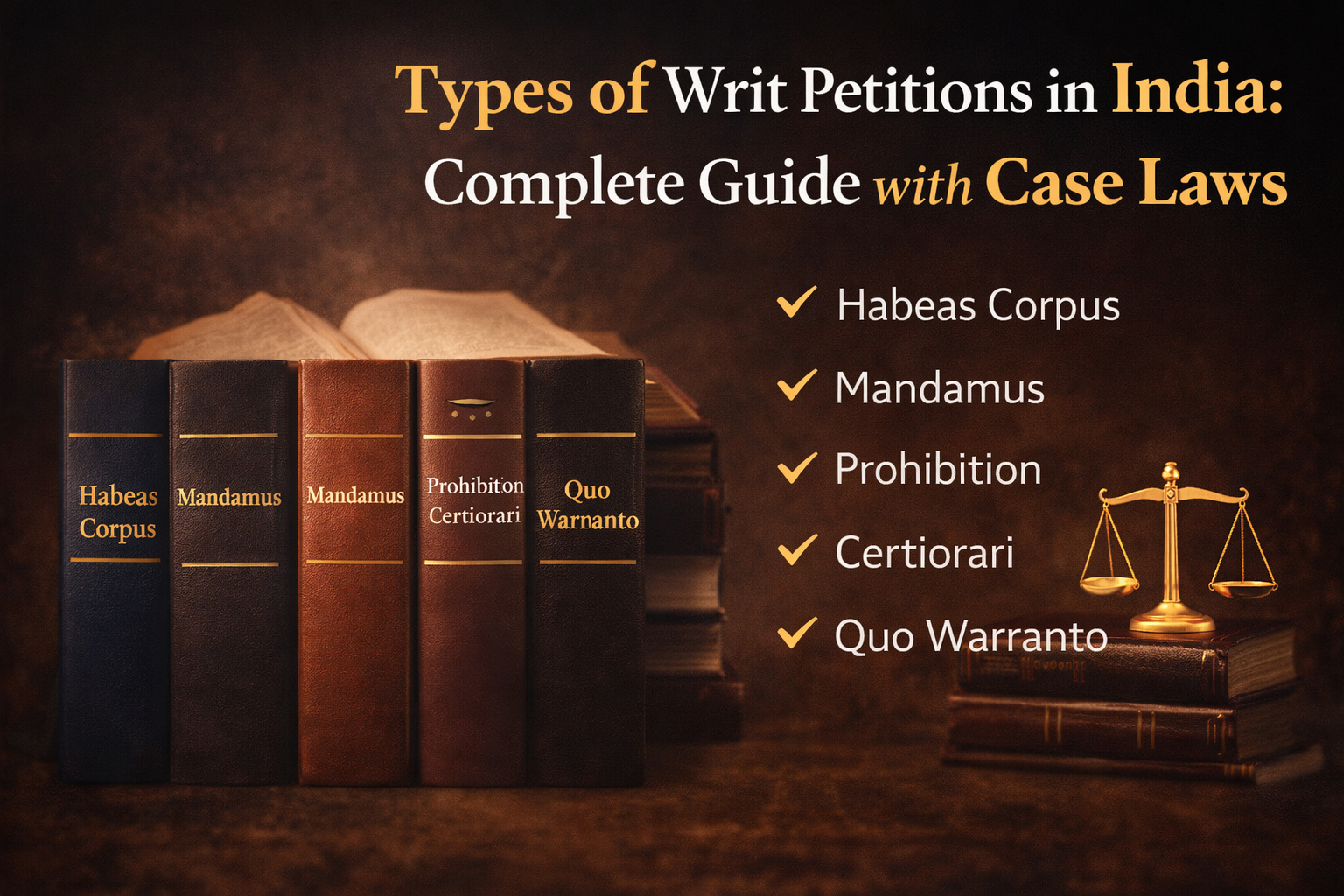
Types of Writ Petitions in India: Complete Guide with Case Laws

The Indian Constitution is celebrated globally for its robust mechanism to protect the liberties and fundamental rights of its citizens. At the heart of this protective framework lies the power of the higher judiciary to issue “Writs.” Writing petitions in India is a highly potent legal remedy available under Article 32 and Article 226 of the Constitution. They empower citizens to approach the Supreme Court and High Courts, respectively, to seek immediate justice against any violation of their constitutional rights.
Whether it is a matter of personal liberty, administrative overreach, or the failure of a public official to perform their duties, writs act as an extraordinary judicial check against arbitrary state action. In this comprehensive guide, Adv. Dhanashree A. Bankhele provides an in-depth exploration of the five types of writ petitions in India, their purposes, and the landmark case laws that have shaped Indian constitutional jurisprudence.
Contact now- 91 9967315556
The Constitutional Basis of Writ Jurisdictions
Before diving into the types of writs, it is crucial to understand where the courts derive this immense power:
- Article 32 (Supreme Court): Dr. B.R. Ambedkar famously referred to Article 32 as the “heart and soul” of the Constitution. It allows any citizen to approach the Supreme Court directly for the enforcement of fundamental rights.
- Article 226 (High Courts): This article grants High Courts the authority to issue writs within their territorial jurisdictions. Notably, the High Court’s writ jurisdiction is broader than the Supreme Court’s because it can be invoked not just for fundamental rights but also for “any other purpose” (such as statutory or legal rights).
The five types of writs recognized in India are Habeas Corpus, Mandamus, Prohibition, Certiorari, and Quo Warranto.
1. Habeas Corpus (To Have the Body)
Definition and Purpose
Derived from the Latin term meaning “you shall have the body,” Habeas Corpus is the ultimate guardian of personal liberty. It is issued when an individual has been illegally or arbitrarily detained by the state, police, or even a private individual. The writ commands the detaining authority to produce the detained person before the court and justify the legal grounds for detention. If the court finds no lawful justification, it orders the immediate release of the person.
Key Aspects
- Locus Standi Relaxed: Unlike other legal proceedings where only the aggrieved party can file a petition, a Habeas Corpus petition can be filed by a relative, friend, or any public-spirited citizen on behalf of the detained person.
- Preventive Detention: It is a vital tool to examine cases of preventive detention to ensure that the state has not exceeded its legal boundaries.
Landmark Case Laws
- ADM Jabalpur v. Shivkant Shukla (1976): Also known as the “Habeas Corpus Case,” the Supreme Court notoriously ruled during the Emergency that the right to seek Habeas Corpus could be suspended. However, this was later rectified.
- Justice K.S. Puttaswamy (Retd.) v. Union of India (2017): In the famous Privacy Judgment, the Supreme Court officially overruled the ADM Jabalpur ruling, reiterating that the right to life and personal liberty is inherent and can never be suspended by the state.
Contact now- 91 9967315556
2. Mandamus (We Command)
Definition and Purpose
The term “Mandamus” means “we command.” It is a directive issued by a higher court to a public official, government body, corporation, or lower tribunal, commanding them to perform a mandatory statutory or public duty that they have failed or refused to execute. It keeps administrative authorities accountable and prevents governmental lethargy.
Conditions for Mandamus
To successfully claim a writ of Mandamus, the petitioner must prove:
- A clear legal right of the petitioner to enforce a performance.
- A corresponding statutory or public duty on the part of the respondent (it cannot be a discretionary duty).
- A demand made to the authority to perform the duty, and a subsequent refusal or failure by the authority.
Landmark Case Laws
- Gujarat State Financial Corp v. Lotus Hotels (1983): The Supreme Court issued a writ of Mandamus directing the financial corporation to release funds it had promised, as it was a public duty, and the failure to do so would cause injustice.
- State of MP v. Mandawara (1954): The court ruled that Mandamus cannot be issued to compel an authority to exercise its “discretionary” powers in a particular way. It only applies to mandatory duties.
3. Prohibition (To Forbid)
Definition and Purpose
Prohibition is a preventive writ. Translated from Latin as “to forbid,” it is issued by a higher court to a lower court, tribunal, or quasi-judicial body to stop it from continuing proceedings. It is invoked when the lower body is exceeding its jurisdiction, acting without jurisdiction, or violating the principles of natural justice. It steps in before a final order is passed to prevent a legal error.
Landmark Case Laws
- East India Commercial Co. Ltd v. Collector of Customs (1962): The Supreme Court held that if an inferior tribunal proceeds to act without jurisdiction or in excess of jurisdiction, a writ of Prohibition can be issued to command it to cease the proceedings.
Contact now- 91 9967315556
4. Certiorari (To Be Certified or Informed)
Definition and Purpose
While Prohibition is preventive, Certiorari is curative. Derived from the Latin term meaning “to be certified,” it is issued by a superior court to quash an order, decision, or judgment already passed by a lower court, tribunal, or quasi-judicial authority. It is sought when the lower authority has acted beyond its jurisdiction, committed an egregious error of law apparent on the face of the record, or violated natural justice.
Landmark Case Laws
- Hari Vishnu Kamath v. Ahmad Ishaque (1955): The Supreme Court established that Certiorari is issued to correct errors of jurisdiction or errors of law apparent on the face of the record, but not to correct mere errors of fact.
- Syed Yakoob v. K.S. Radhakrishnan (1964): The court reiterated that a writ of Certiorari cannot be used as an appeal in disguise. The High Court cannot re-appreciate evidence as an appellate court; it can only examine jurisdictional and legal flaws.
5. Quo Warranto (By What Authority)
Definition and Purpose
Quo Warranto translates to “by what warrant or authority.” It is issued to inquire into the legality of a person holding a public office. If a person occupies a public office without possessing the requisite qualifications or legal authority, the court can issue this writ to oust them and declare the position vacant. Its primary objective is to prevent the unauthorized usurpation of public offices and to uphold the integrity of public service.
Conditions for Quo Warranto
- The office must be of a public nature and created by a statute or the Constitution.
- The office must be substantive (not a mere private or contractual job).
- The person holding it must be doing so without legal qualification.
Landmark Case Laws
- University of Mysore v. Govinda Rao (1965): The Supreme Court held that the petitioner must show that the office in question is a substantive public office and is being held by the respondent without any legal authority.
Contact now- 91 9967315556
Additional Legal Remedies: Understanding Inherent Powers under New Laws
While writ petitions remain the ultimate constitutional remedies, modern Indian jurisprudence relies heavily on procedural codes to ensure justice in day-to-day legal disputes. For instance, the High Courts possess vast inherent powers to prevent the abuse of any judicial process and to secure the ends of justice.
With the modernization of Indian criminal laws—such as the transition to the Bharatiya Nagarik Suraksha Sanhita (BNSS) (which replaces the old CrPC)—the judiciary has maintained its steadfast commitment to filtering out frivolous litigation, quashing baseless First Information Reports (FIRs), and rectifying biased investigations. Whether a citizen is approaching the High Court under constitutional writ jurisdictions or utilizing the inherent statutory powers of the High Court to quash malicious litigation, the ultimate goal remains the same: the preservation of human dignity, transparency, and the rule of law.
Conclusion
Understanding the types of writ petitions in India is crucial for every citizen, legal practitioner, and even non-resident Indians (NRIs) who seek legal redressal for property, contractual, or personal rights in the country. From Habeas Corpus safeguarding personal liberty to Quo Warranto protecting public institutions, writs are the structural pillars of Indian democracy. They keep governmental overreach in check and ensure that administrative bodies do not trample upon the rights of the common person.
If your fundamental or legal rights are being violated, approaching a qualified legal expert who understands procedural nuances is critical.
Contact now- 91 9967315556
FAQs
1. What are the types of writ petitions in India?
Ans. There are five types of writ petitions in India: Habeas Corpus, Mandamus, Certiorari, Prohibition, and Quo Warranto. These are constitutional remedies used to protect legal and fundamental rights.
2. What is the difference between Article 32 and Article 226?
Ans.Article 32 allows citizens to approach the Supreme Court for enforcement of fundamental rights, while Article 226 empowers High Courts to issue writs for both fundamental and legal rights.
3. When can a writ petition be filed in India?
Ans.A writ petition can be filed when a person’s fundamental or legal rights are violated by the government, public authority, or any administrative body.
4. What is Habeas Corpus and when is it used?
Ans.Habeas Corpus is used to challenge illegal detention. The court orders the authority to produce the detained person and justify the detention.
5. What is Mandamus in Indian law?
Ans.Mandamus is a writ issued by a court directing a public authority to perform a legal duty that it has failed or refused to carry out.
6. What is the purpose of Certiorari and Prohibition writs?
Ans.Prohibition prevents a lower court from exceeding its jurisdiction, while Certiorari is used to quash an already passed illegal order or decision.
7. What is Quo Warranto and when can it be filed?
Ans.Quo Warranto is used to question the legality of a person holding a public office without proper authority or qualifications.
8. Can a writ petition be filed in the High Court directly?
Ans.Yes, under Article 226, a writ petition can be filed directly in the High Court, which has wider jurisdiction than the Supreme Court.
9. Are writ petitions available for non-fundamental rights?
Ans.Yes, High Courts can issue writs not only for fundamental rights but also for other legal rights under Article 226.
10. How can a lawyer help in filing a writ petition in India?
Ans.A qualified lawyer helps in drafting the petition, presenting legal arguments, and ensuring proper filing before the Supreme Court or High Court for effective relief.
Check About – How a Husband Can Deal with a False Section 498A Case (Section 85 BNS Guide)