
What Is Section 352 BNS in 2026? Important Meaning, Serious Punishment & Complete Guide

If you are searching for Section 352 BNS in 2026, here is the direct answer you need: Section 352 of the Bharatiya Nyaya Sanhita, 2023 deals with intentional insult with intent to provoke breach of peace. It applies when a person intentionally insults another person and does so intending, or knowing it to be likely, that the provocation may cause that person to break public peace or commit another offence. The Bharatiya Nyaya Sanhita is currently in force, and Section 352 remains the applicable legal provision in 2026.
A lot of people still get confused because they mix old IPC sections with the new BNS numbering. Under the old Indian Penal Code, this legal idea was covered by Section 504 IPC. Under the new BNS structure, the corresponding provision is Section 352 BNS. The official comparative table confirms this change.
That means if someone searches “provocation punishment under BNS,” “Section 352 BNS bailable or not,” or “IPC 504 in BNS,” they are all usually trying to reach the same legal point: intentional insult that is likely to provoke breach of peace. This article explains the law in simple words, with a structure designed to rank for both users and search engines.
Section 352 BNS in 2026 means intentional insult with intent to provoke breach of peace. A person who intentionally insults another person, knowing or intending that it may provoke breach of public peace or another offence, can be punished with imprisonment up to two years, or fine, or both. Section 352 BNS is the new-law equivalent of old IPC Section 504.
Section 352 BNS Meaning in Simple Words
In simple terms, Section 352 BNS is not about every rude word or every angry argument. The law is more specific. It punishes an insult only when that insult is used in a way that is meant to provoke someone into unlawful action or public disorder. The official heading itself reads “Intentional insult with intent to provoke breach of peace.”
This makes one thing very clear: the offence is not just about insult. It is about insult plus provocation plus likely breach of peace. That is the real legal meaning of Section 352 BNS in 2026.
What Does Section 352 BNS Say?
The statutory idea behind Section 352 is straightforward. If a person intentionally insults another person, and by doing so gives provocation, intending or knowing that such provocation is likely to cause that person to break public peace or commit any other offence, the person can be punished under this section. The maximum punishment is two years, or fine, or both.
This is why the law does not automatically punish ordinary rude behavior. The prosecution must show more than harsh words. It must show that the insult was deliberate and linked to likely unlawful consequences.
Punishment Under Section 352 BNS
The punishment under Section 352 BNS is:
imprisonment for a term which may extend to two years, or
fine, or both.
This punishment structure gives the court flexibility. In some matters, a fine may be enough. In more serious matters, imprisonment may be considered appropriate. The punishment depends on the facts, the intention, and the seriousness of the provocation.
Is Section 352 BNS Bailable or Not?
Yes. Section 352 BNS is bailable. The official First Schedule classification also lists it as non-cognizable and triable by Any Magistrate.
This point is important because many websites wrongly state mixed classifications. For Section 352 itself, the official schedule supports the classification as:
Non-cognizable
Bailable
Triable by Any Magistrate
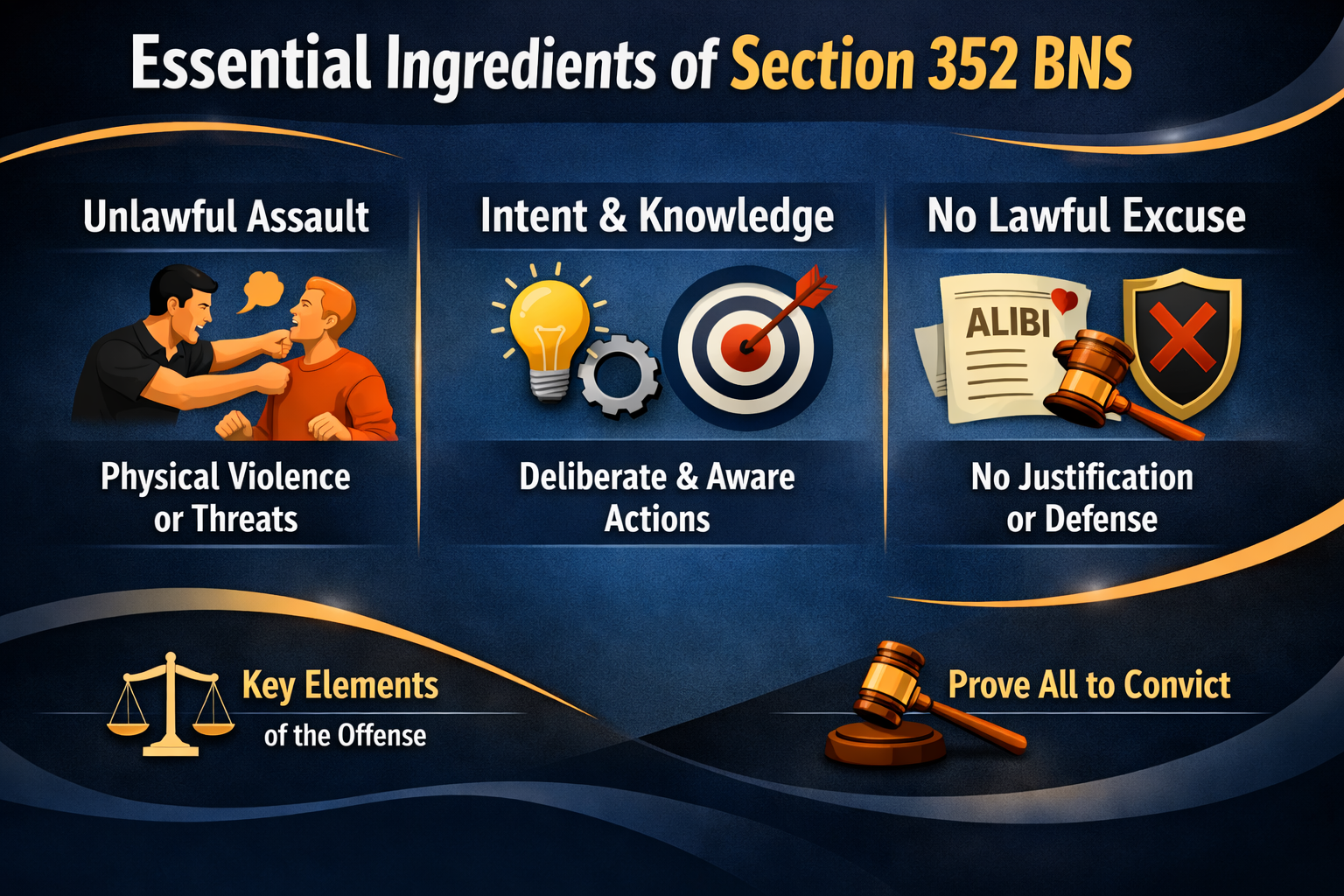
Essential Ingredients of Section 352 BNS
To understand when Section 352 BNS may apply, these ingredients are important:
1. Intentional insult
The insult must be deliberate. It should not be accidental or casual. The law specifically requires intentional insulting conduct.
2. Provocation
The insult must amount to provocation. The law is concerned with insults that can trigger a reaction, not just mild annoyance.
3. Intention or knowledge
The accused must either intend that the insult may lead to breach of peace, or know that such a result is likely. This mental element is central to the offence.
4. Likely breach of peace or another offence
There must be a likely result connected to public disorder or another offence. That is why Section 352 is treated as a public-order-related provision and not just a private hurt-feelings section.
Section 352 BNS and IPC 504
One of the most searched legal questions is: Which IPC section became Section 352 in BNS?
The answer is: IPC Section 504 became BNS Section 352 in substance and subject matter. The official comparative material confirms this section mapping between the old IPC and the new BNS framework.
So, if you are reading an older legal article on Section 504 IPC, the updated 2026 reference is Section 352 BNS.
Real-Life Examples of Section 352 BNS
Here are simple examples that help users understand the section better:
A person abuses another person loudly in a crowded public place, hoping that the other person will attack him. If the facts support deliberate provocation and likely breach of peace, Section 352 may apply.
A person repeatedly uses insulting words during a property dispute, knowing the other side is likely to react violently. That may also fall under Section 352 BNS.
A person posts highly targeted insulting content aimed at provoking supporters of another group into unlawful retaliation. Depending on the facts, this may attract Section 352 because the section covers insult “in any manner.” This is a reasonable legal inference from the text of the provision.
At the same time, every rude comment does not become a criminal offence. If two people exchange angry words but there is no clear intention to provoke unlawful conduct, Section 352 may not automatically apply.
Common Confusion About Section 352 BNS
Many users search this section thinking it refers to “grave and sudden provocation” in the old sense attached to a different numbering system. That is a major mistake. Under the Bharatiya Nyaya Sanhita, 2023, Section 352 is specifically about intentional insult with intent to provoke breach of peace. The official chapter listing confirms this heading directly.
Why Section 352 BNS Matters in 2026
Section 352 BNS matters in 2026 because social conflict spreads faster now. Disputes in families, neighborhoods, workplaces, political settings, and online spaces can escalate quickly. The law recognizes that insults are not always harmless. Sometimes they are used deliberately to trigger violence, retaliation, or public disorder. That is exactly the zone where Section 352 becomes relevant.
Recent reporting has also shown Section 352 being invoked in cases involving provocative slogans and targeted online abuse where authorities alleged risks to public order. Those news reports do not define the law, but they do illustrate how the provision is being used in contemporary settings.
Legal Insight for Practical Understanding
In real cases, courts and lawyers usually examine the exact words used, the place where they were used, whether there was an ongoing dispute, whether the insult was public or private, and whether breach of peace was a likely result. These facts often decide whether the matter remains a simple quarrel or becomes a punishable offence under Section 352 BNS. This is an inference from the structure of the offence, especially its focus on intention, provocation, and likely consequence.
As legal professionals such as Adv. Dhanashree A. Bankhele would naturally note, a short legal section can still involve complex factual questions about mens rea, context, and public order.
Conclusion
To sum up, Section 352 BNS in 2026 means intentional insult with intent to provoke breach of peace or another offence. It is the current BNS equivalent of old IPC Section 504, and the punishment can extend to two years’ imprisonment, or fine, or both. The official schedule classifies the offence as non-cognizable, bailable, and triable by Any Magistrate.
So if your question is “What is Section 352 BNS in 2026?”, the correct answer is simple: it is the law that punishes deliberate insulting conduct used to provoke breach of peace.
FAQs
1. What is Section 352 BNS in 2026?
Section 352 BNS deals with intentional insult with intent to provoke breach of peace under the Bharatiya Nyaya Sanhita, 2023.
2. What is the punishment under Section 352 BNS?
The punishment may extend to two years’ imprisonment, or fine, or both.
3. Is Section 352 BNS bailable?
Yes. Section 352 BNS is classified as bailable.
4. Is Section 352 BNS cognizable or non-cognizable?
It is classified as non-cognizable in the official schedule.
5. Which old IPC section matches Section 352 BNS?
The matching old provision is IPC Section 504.
6. Which court tries Section 352 BNS cases?
It is triable by Any Magistrate.
7. Does every insult fall under Section 352 BNS?
No. The insult must be intentional and linked to likely breach of peace or another offence.
8. Can social media abuse fall under Section 352 BNS?
It can, depending on the facts, if the insulting conduct is used to provoke breach of peace or another offence. This is an inference from the section’s wording and recent reported usage.
9. When did BNS come into force?
The Bharatiya Nyaya Sanhita came into force on 1 July 2024.
10. What is the main ingredient of Section 352 BNS?
The main ingredient is intentional insult combined with intent or knowledge that it is likely to provoke breach of peace or another offence.
11. Can fine alone be imposed under Section 352 BNS?
Yes. The law allows punishment by fine, imprisonment, or both.
12. Is Section 352 BNS about grave and sudden provocation?
No. Under BNS, Section 352 is specifically about intentional insult with intent to provoke breach of peace.
13. Why is Section 352 BNS important in 2026?
It is important because it addresses deliberate insulting conduct used to trigger public disorder or other offences under the current criminal law framework.
14. Can a verbal fight become a Section 352 case?
Yes, but only when the legal ingredients are present and breach of peace is a likely result.
15. Should a person take legal advice in a Section 352 matter?
Yes. The result in such matters often depends on intention, evidence, surrounding facts, and the full set of allegations.