

What is Divorce Mediation? How It Helps You Avoid Court Battles

Divorce is hard enough without turning every issue into a long court fight. Many couples do not only worry about the end of the marriage. They also worry about what comes next—child custody, parenting schedules, alimony, property, daily expenses, and family stress. This is exactly why divorce mediation has become so important. In India, mediation is now backed by a stronger legal framework through the Mediation Act, 2023, while Family Courts continue to have a statutory duty to make efforts for settlement in family disputes.
If you are asking how divorce mediation can help you avoid court battles, the answer is simple: it gives both spouses a chance to resolve key issues through structured discussion instead of full litigation. Mediation is less adversarial than a courtroom fight, can preserve communication, is generally confidential, and may save time and legal cost when both sides are willing to engage honestly. The Department of Legal Affairs describes mediation as less adversarial and informal than conventional litigation, and says it can help preserve relationships while saving time and resources.
For many families, that difference matters more than anything else.
What Is Divorce Mediation?
Divorce mediation is a process in which a neutral third person helps separating spouses talk through their disputes and try to reach a mutually acceptable settlement. Under the Mediation Act, “mediation” includes pre-litigation mediation, online mediation, community mediation, and even processes referred to by similar expressions, where parties attempt to reach an amicable settlement with the assistance of a third person.
This means mediation is not the same as a judge deciding your case. The mediator does not impose a result like a court. Instead, the mediator manages the process and helps both sides communicate better, identify issues, and work toward practical solutions. NALSA-linked mediation resources also describe mediation as a structured yet informal process in which the parties control the outcome, while the mediator controls the process.
That one difference changes the whole tone of the dispute.
Contact now- 91 9967315556
Why Court Battles Become So Draining
Court litigation in divorce matters can become emotionally and financially exhausting. Hearings may take time. Allegations can become harsher. Communication often breaks down completely. Small disagreements can turn into full legal battles. The Department of Legal Affairs states that traditional litigation is lengthy, causes delay, and adds to the burden on the judiciary, which is one reason ADR methods like mediation are being strengthened.
Family law disputes are especially sensitive because they are not only about law. They are about relationships, children, routines, family dignity, and future stability. That is why the Family Courts Act, 1984 itself was enacted to promote conciliation and secure speedy settlement of disputes relating to marriage and family affairs, and Section 9 specifically says Family Courts should make efforts, in the first instance where possible, to assist and persuade parties to arrive at a settlement.
So, from a legal and practical point of view, mediation is not a side idea. It is closely aligned with the design of family dispute resolution in India.

How Divorce Mediation Helps You Avoid Court Battles
1. It Shifts the Focus From Fighting to Solving
In court, each side usually tries to prove why the other side is wrong. In mediation, the focus changes. The real question becomes: what solution can both sides live with? That shift reduces hostility and often makes progress possible.
This is one reason mediation works well in divorce matters. It gives space for discussion on practical issues like maintenance, child arrangements, residence, finances, and closure without turning every point into adversarial evidence.
2. It Supports Settlement Early
The Mediation Act recognizes pre-litigation mediation, which means parties may voluntarily try mediation before filing a civil proceeding, and court-annexed mediation centres can also conduct it.
That matters because early settlement can prevent years of unnecessary litigation. If the couple reaches agreement before the dispute grows into multiple cases, they may avoid a much larger court battle later.
3. It Is Generally Confidential
Privacy matters deeply in family disputes. Under Section 22 of the Mediation Act, the mediator, mediation service provider, parties, and participants must keep mediation matters confidential, including suggestions, admissions, and proposals made during mediation.
That makes mediation attractive for couples who do not want every emotional statement or negotiation point to become part of a public legal fight. Family Court proceedings may also be held in camera if the court so desires, and must be held that way if either party so desires, showing how seriously privacy is treated in family matters.
4. It Can Preserve Working Relationships
Not every divorce ends with total hostility. Sometimes both spouses know the marriage must end, but they still need to co-parent, attend school events, make medical decisions for children, or manage financial transitions. The statement of objects behind the Mediation Act notes that mediation fosters a collaborative approach, reduces the burden on courts, and preserves relationships among disputants.
In a divorce, preserving the marriage may not be possible. But preserving a workable future relationship can still be very important.
5. It Can Save Time
The Department of Legal Affairs says the Mediation Act provides a framework that includes completion of the mediation process within a maximum period of 180 days. Its summary of the law also notes that mediated settlements are final, binding, and enforceable in accordance with the Code of Civil Procedure in the same manner as a judgment or decree of a court.
That does not mean every mediation ends quickly. But compared with prolonged contested litigation, mediation can often move faster when both sides participate seriously.
6. It Gives More Control to the Couple
A judge decides a case based on pleadings, evidence, and law. In mediation, the couple has more control over the final terms. They can shape parenting schedules, payment plans, visitation structures, and timelines in a more practical way than a court order sometimes allows.
This flexibility is one of the biggest reasons many lawyers and family dispute professionals prefer mediation where settlement is realistically possible.
Contact now- 91 9967315556
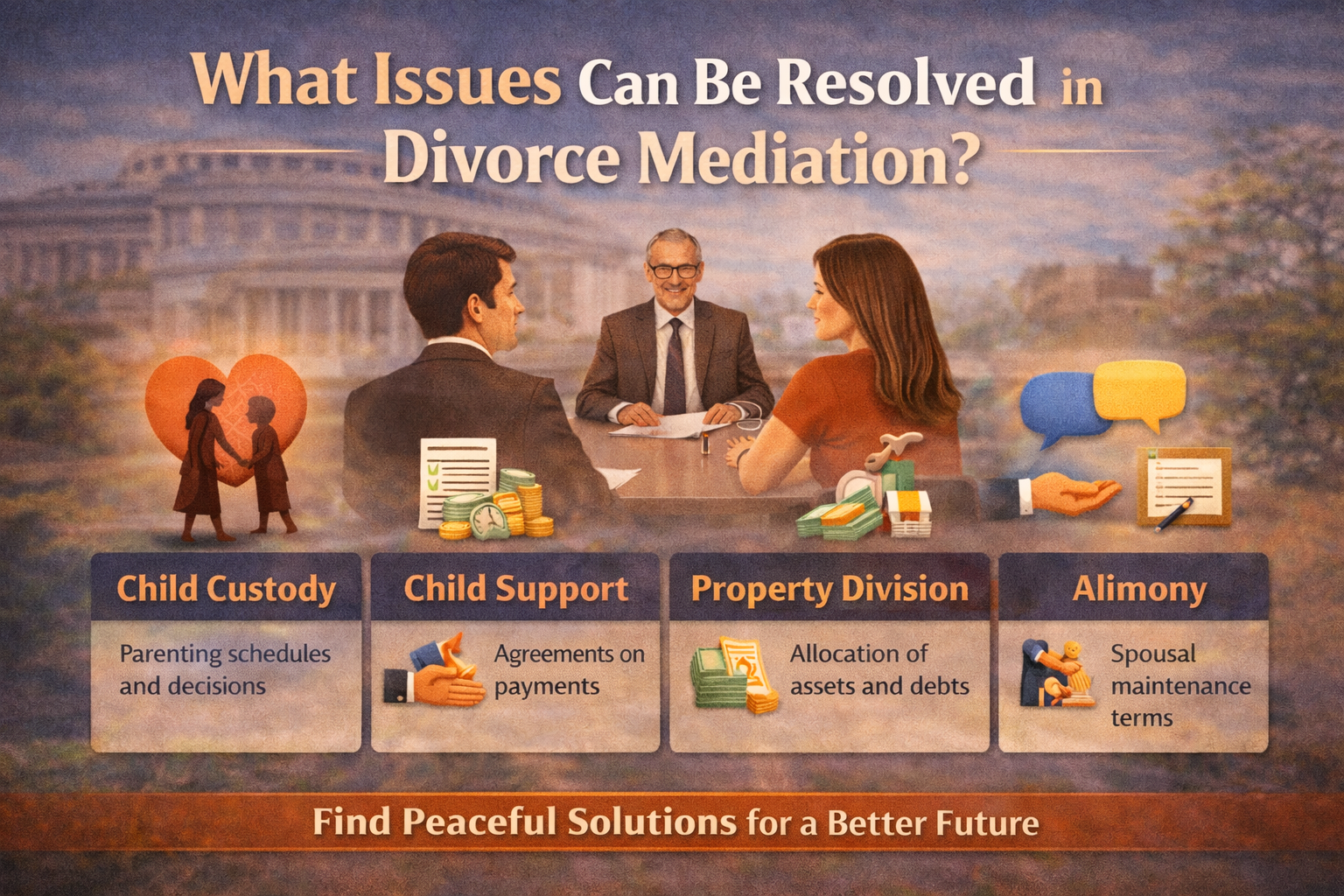
What Issues Can Be Resolved in Divorce Mediation?
Divorce mediation is commonly used to discuss:
- mutual consent divorce terms
- alimony or maintenance
- child custody and visitation
- parenting schedules
- education and medical expenses of children
- division of household responsibilities during transition
- return of personal articles or documents
- closure of related complaints where legally permissible
The Mediation Act also makes it clear that while some matters are not fit for mediation, courts may still refer certain compoundable matrimonial offences pending between the parties to mediation where appropriate.
That gives family disputes meaningful room for negotiated resolution.
Is Online Divorce Mediation Possible?
Yes. The Mediation Act expressly provides for online mediation. Section 30 allows online mediation, including pre-litigation mediation, with the written consent of the parties, and it can be conducted using video, audio, encrypted email, secure chat rooms, or other electronic means, while maintaining confidentiality and integrity of the process.
This is especially useful in 2026 when spouses may live in different cities or even different countries. Online mediation can reduce travel stress and make scheduling easier.
Contact now- 91 9967315556
When Mediation May Work Best
Mediation usually works best when:
- both spouses are willing to talk
- both want practical closure
- there is some openness to compromise
- child-related issues need calmer discussion
- the parties want privacy
- they want to avoid a long and public fight
As legal professionals such as Adv. Dhanashree A. Bankhele often emphasize in family disputes, the right process can shape the outcome as much as the legal position itself. In many separations, mediation is not about “giving up” legal rights. It is about using a smarter path to protect time, dignity, and family stability.
When Mediation May Not Be Enough
Mediation is helpful, but it is not a magic solution for every case. The Mediation Act itself contains a list of disputes or matters not fit for mediation, and allows challenge to a mediated settlement on limited grounds such as fraud, corruption, impersonation, or mediation of matters not fit for mediation.
In practical terms, mediation may be difficult where there is extreme imbalance, dishonesty, refusal to disclose finances, or no willingness at all to negotiate. In such cases, court protection and formal adjudication may still be necessary.

Why Mediation Is Often Better Than a Full Court Fight
The strongest reason mediation helps people avoid court battles is that it changes the goal. Litigation often asks, “Who wins?” Mediation asks, “What can work?” In family disputes, that question is usually more helpful.
The legal system in India already reflects that idea. Family Courts are expected to make efforts for settlement, and the Mediation Act now gives mediation a stronger statutory base, including confidentiality, online mediation, institutional support, and enforceability of settlement agreements.
So, for many couples, mediation is not a weak option. It is often the more mature and more effective option.
Contact now- 91 9967315556
Final Thoughts
How divorce mediation can help you avoid court battles is not only a legal question. It is a life question. For many families, mediation offers a calmer, more private, and more solution-focused path through separation. It can reduce hostility, save time, protect communication, and help couples settle important issues without turning everything into a prolonged courtroom fight. India’s legal framework now supports that path more clearly through the Mediation Act, 2023 and the continued settlement-focused structure of the Family Courts Act, 1984.
For readers trying to make responsible decisions during a difficult time, that makes mediation worth serious consideration.
FAQs
1. What is divorce mediation?
Divorce mediation is a process where a neutral third person helps separating spouses try to reach an amicable settlement on disputed issues.
2. Is divorce mediation legally recognized in India?
Yes. India has a statutory mediation framework under the Mediation Act, 2023, and Family Courts are also required to make efforts for settlement in family disputes.
3. Can divorce mediation help avoid court?
Yes. It can help parties resolve issues before or during litigation, reducing the need for a long contested court battle.
4. Is mediation confidential in divorce cases?
Yes. The Mediation Act requires confidentiality for mediation communications, proposals, and admissions, subject to the Act.
5. Can mediation happen before filing a divorce case?
Yes. The Mediation Act recognizes voluntary pre-litigation mediation.
6. Can divorce mediation be done online?
Yes. The Mediation Act expressly provides for online mediation with written consent of the parties.
7. Is a mediated settlement enforceable?
Yes. A mediated settlement agreement under the Act is binding and enforceable like a judgment or decree of a court, subject to the Act.
8. How long can mediation take?
The Department of Legal Affairs states that the Mediation Act framework contemplates completion within 180 days, with limited extension in the legal scheme.
9. What issues can be settled in divorce mediation?
Common issues include maintenance, child custody, visitation, parenting plans, and property-related settlement terms, depending on the case.
10. Does mediation mean the mediator decides the case?
No. The mediator helps the process, but the parties control whether to settle and on what terms.
11. Are Family Courts required to encourage settlement?
Yes. Section 9 of the Family Courts Act requires Family Courts to make efforts to assist and persuade parties to arrive at a settlement where possible.
12. Is mediation always suitable in divorce matters?
No. The Mediation Act recognizes that some disputes are not fit for mediation, and real suitability depends on the facts of the case.