
How to Get Bail in NDPS Cases in India: Law, Conditions & Process

The Narcotic Drugs and Psychotropic Substances (NDPS) Act, 1985, is one of the most stringent laws in the Indian legal system. Designed to curb the menace of drug trafficking and substance abuse, the Act carries heavy penalties and a rigorous framework for the grant of bail. Navigating these complexities requires a deep understanding of both the law and the latest judicial precedents. Adv. Dhanashree A. Bankhele, a seasoned legal professional, specializes in providing strategic defense and representation in NDPS cases in India, ensuring that the rights of the accused are protected within this tough legislative environment.
What are NDPS Cases in India?
The NDPS Act prohibits the manufacture, possession, sale, purchase, transport, warehouse, use, consumption, import inter-state, export inter-state, import into India, export from India, or transshipment of any narcotic drug or psychotropic substance, except for medical or scientific purposes.
Adv. Dhanashree A. Bankhele emphasizes that the severity of the punishment—and consequently the difficulty of obtaining bail—depends largely on the quantity of the substance recovered. The law categorizes quantities into three types:
- Small Quantity: Relatively lenient punishment and easier bail prospects.
- Intermediate Quantity: Moderate penalties; bail is subject to standard judicial discretion.
- Commercial Quantity: Extremely stringent; bail is the exception, not the rule.
Contact now- 91 9967315556
Understanding Bail under the NDPS Act
In standard criminal cases, the rule is “Bail, not Jail.” However, in NDPS cases in India, the script is often flipped, especially when commercial quantities are involved. Section 37 of the NDPS Act creates a significant hurdle for the accused.
The Rigors of Section 37
For offenses involving commercial quantities, Section 37 imposes “Twin Conditions” that must be satisfied before a court can grant bail:
- The Public Prosecutor’s Opportunity: The prosecutor must be given an opportunity to oppose the bail application.
- Reasonable Grounds for Innocence: The court must be satisfied that there are reasonable grounds for believing that the accused is not guilty of such an offense and that they are not likely to commit any offense while on bail.
According to Adv. Dhanashree A. Bankhele, these conditions shift a heavy burden onto the defense to show a prima facie case of innocence at the very start of the proceedings.
Confession under the NDPS Act: A Critical Turn
A pivotal moment in the legal landscape of Bail in NDPS Cases came with the landmark Supreme Court ruling in the Tofan Singh vs. State of Tamil Nadu case.
The Status of Section 67 Statements
Previously, officers under the NDPS Act were not considered “police officers” in the traditional sense, meaning confessions made to them under Section 67 were often admitted as evidence. However, the judiciary has now clarified that:
- Officers of the Central/State agencies under the NDPS Act are indeed “police officers.”
- Any confession made to them is inadmissible in evidence.
Adv. Dhanashree A. Bankhele utilizes this precedent to challenge the prosecution’s case, particularly when the entire charge is built solely on a forced or coerced statement from the accused. This often becomes a primary ground for seeking Bail in NDPS Cases in India.
Contact now- 91 9967315556
Key Grounds for Seeking Bail in NDPS Cases
Securing freedom in NDPS drug cases requires identifying procedural lapses and legal technicalities. Adv. Dhanashree A. Bankhele focuses on several critical areas:
1. Non-Compliance with Section 42
Section 42 mandates that any officer receiving information about an offense must record it in writing and inform their superior officer within 72 hours. Failure to follow this mandatory procedural requirement can vitiate the entire search and seizure, creating a strong ground for bail.
2. The Right to be Searched (Section 50)
When a personal search is conducted, the officer must inform the suspect of their right to be searched in the presence of a Gazetted Officer or a Magistrate. If this right is not clearly communicated, the recovery may be deemed illegal.
3. Sampling and Inventory (Section 52A)
The law requires that samples be drawn in the presence of a Magistrate. If the police draw samples independently at the site of seizure without judicial supervision, it constitutes a major procedural flaw that Adv. Dhanashree A. Bankhele highlights during bail hearings.
4. Prolonged Incarceration
If the trial is moving at a snail’s pace and the accused has already spent a significant amount of time in jail (without the trial’s delay being their fault), the courts may grant bail based on the right to a speedy trial under Article 21.
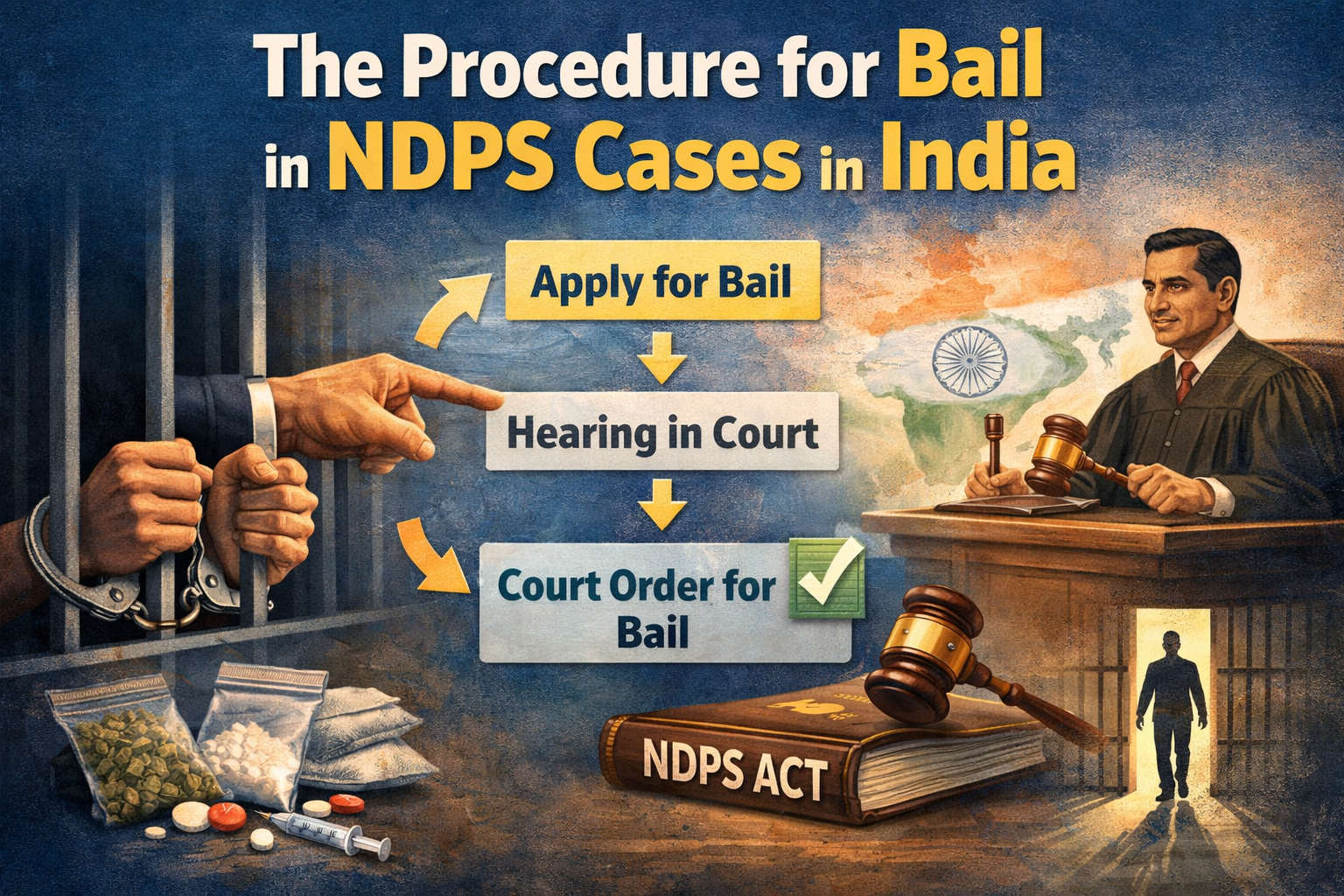
The Procedure for Bail in NDPS Cases in India
The path to obtaining Bail in NDPS Cases usually involves the following steps:
- Special NDPS Court: Most applications are first moved before the Special Court designated for NDPS matters.
- High Court Intervention: If the Special Court rejects the application, a petition is moved to the High Court under Section 439 of the CrPC (now relevant sections of the BNSS).
- Anticipatory Bail: While difficult in commercial quantity cases, Anticipatory Bail can be sought if there is a legitimate fear of false implication or if the person’s name has surfaced only through a co-accused’s inadmissible confession.
| Quantity Involved | Typical Bail Outcome | Key Consideration |
| Small Quantity | Generally Granted | Bailable nature of the offense |
| Intermediate | Discretionary | Facts and circumstances of the case |
| Commercial | Difficult | Section 37 “Twin Conditions” |
Why Representation Matters: The Role of Adv. Dhanashree A. Bankhele
In the high-stakes world of NDPS drug cases, the margin for error is zero. Adv. Dhanashree A. Bankhele provides a comprehensive defense strategy that includes:
- Scrutiny of the Panchnama: Analyzing the recovery memo for inconsistencies.
- FSL Report Analysis: Checking the chemical analysis reports for discrepancies in the substance identified.
- Challenging the Chain of Custody: Ensuring that the drugs seized at the spot are the exact same ones produced in court.
- Navigating New Laws: Staying updated with the 2026 transition to the Bharatiya Nagarik Suraksha Sanhita (BNSS) to ensure all procedural rights are exercised.
Contact now- 91 9967315556
Conclusion
Understanding Bail under the NDPS Act is about recognizing that while the law is harsh, it is not arbitrary. Every accused person has the right to a fair trial and a robust defense. The complexities of search, seizure, and the inadmissible nature of confessions require a specialized approach. Adv. Dhanashree A. Bankhele stands at the forefront of this legal battle, providing meticulous representation for those caught in the web of NDPS Cases in India.
Whether you are dealing with a small quantity or a more complex commercial charge, the goal remains the same: ensuring that justice is served through the strict application of legal safeguards and procedural integrity.
FAQs
1. Is bail possible in NDPS cases in India?
Yes, bail is possible in NDPS cases, but it depends on the quantity of the substance and compliance with legal procedures. In commercial quantity cases, bail is difficult due to strict conditions under Section 37.
2. What are the conditions for bail under Section 37 of the NDPS Act?
The court must be satisfied that:
-
The accused is not guilty, and
-
They are unlikely to commit any offense while on bail
Also, the Public Prosecutor must be given a chance to oppose the bail.
3. How does the quantity of drugs affect bail in NDPS cases?
-
Small quantity: Bail is usually granted
-
Intermediate quantity: Depends on case facts
-
Commercial quantity: Bail is very difficult
4. What is the role of procedural lapses in getting bail?
Procedural errors like non-compliance with Sections 42, 50, or 52A can weaken the prosecution’s case and become strong grounds for bail.
Contact now- 91 9967315556
5. Can a confession under NDPS law be used against the accused?
No. As per the Tofan Singh vs. State of Tamil Nadu judgment, confessions made to NDPS officers are not admissible in evidence.
6. How long does it take to get bail in NDPS cases?
The timeline varies depending on the court, case complexity, and legal strategy. However, prolonged incarceration without trial can be a valid ground for bail.
7. Can anticipatory bail be granted in NDPS cases?
Yes, but it is rare in cases involving commercial quantity. It may be granted if there is a risk of false implication or weak evidence.
8. What courts handle NDPS bail applications in India?
Bail applications are first filed in the Special NDPS Court. If rejected, the accused can approach the High Court.
9. Why is legal representation important in NDPS cases?
NDPS laws are highly technical and strict. A skilled lawyer can identify procedural errors, challenge evidence, and build a strong defense strategy.
10. How can Adv. Dhanashree A. Bankhele help in NDPS bail cases?
Adv. Dhanashree A. Bankhele provides expert legal representation by:
-
Challenging procedural violations
-
Analyzing evidence and FSL reports
-
Building strong bail arguments